May 19, 2026


In April 2007, after two years of intensive planning –and with the Ayrshire Coastal Path scheduled to open in summer 2008 – the future of the route suddenly became uncertain. Our preferred line along the old railway track to Fisherton, then down to Dunure, was no longer an option and had to be replaced with an alternative passage along the shore from Dunure to the Heads of Ayr.
While prospecting this new route past Fisherton Bay, we encountered a major problem. To the north lay a rough, rocky shore below the cliffs – very slippery, only passable at certain tide heights, and far too hazardous for most walkers to tackle. It looked like a dead end. The only possible escape route to the clifftops was a seemingly impenetrable, steep slope, thick with bracken and brambles, leading up to a narrow gap in the cliffs.
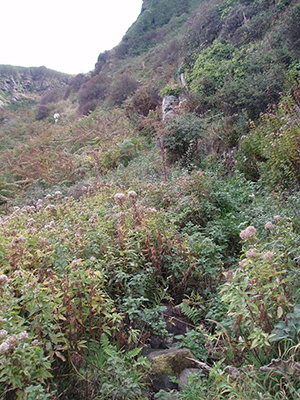
Then, by chance, on the shore, Jimmy Begg– architect of the Coastal Path and a keen naturalist – spied a few roe deer tracks heading diagonally upwards, traversing the slope through the bracken. He followed them and emerged right at the narrow gully.
Blessing the roe deer’s instinctive wisdom in choosing such a brilliant natural line up the slope, Jimmy, with the help of Gus Iannotti and Archie McGregor, began digging out a narrow cut-and-fill path along this line. They were soon joined by another half-dozen able-bodied Ayr Rotarians, who helped continue and complete the 250m route to the top of the cliffs.
A series of rough wooden steps, with concrete slabs bridging the sheuch running down the gully, served walkers well for ten years – until rot and rain erosion made a more robust solution essential.


From September 2017, throughout the winter, spring, summer and autumn, until December 2018, a gang of up to a dozen Rotarian and non-Rotarian volunteer Pathminders devoted fourteen months and 764 man-hours to transforming the route.
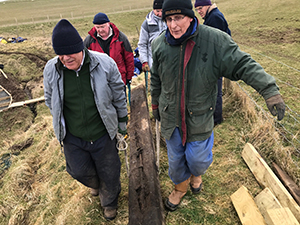
Their work included the construction of over 100 stout wooden steps; the man-handling of a dozen old railway sleepers to build bridges and steps; and the recovery of heavy concrete byre slabs salvaged from an old farm tip to form sturdy edging kerbs. Rubble bags were shifted manually and by gravity, using rope haulage and fishbox-chute slides, transferring some 15 tonnes of whin chips to surface the full 250m of path downhill from clifftop to the Fisherton Bay shore.

None of this could have been achieved without the huge and ongoing support of Allan and Maureen Currie of Fisherton Farm. Not only did they grant permission for the path and steps, they also provided invaluable tractor and trailer transport on site, moving fifteen one-tonne bags of whinchips, railway sleepers and timber from the farm.
Thanks, Allan and Maureen!

This was a fantastic teamwork effort by a great bunch of people, working in all weathers to accomplish such a feat of practical engineering with basic tools and ingenuity. There was also great satisfactionin stepping aside during workdays as peching walking groups carefully climbed up Fisherton Gully, breathlessly expressing their appreciation and thanks for what the Pathminders had achieved with their bare hands over such difficult terrain.

By the winter of 2025, despite regular gardening efforts by our volunteers over the years, heavy vegetation growth had begun to encroach on the steps, making them increasingly hazardous. Over the course of several workdays – often in less-than-favourable weather – our team committed 34 man-hours to clearing all vegetation from the step risers and whin-chip surfaces, from the bottom to the very top of the gully path.
With the steps now restored to their former ‘pristine’ condition, we are determined to stay firmly on top of vegetation growth in future, ensuring this section of the path continues to meet the high standard walkers have come to expect.
The Fisherton Gully Steps stand as a proud monument to the Pathminders, and to the achievement of our biggest and most vital project in securing the long-term future and success of the Ayrshire Coastal Path.